
by Jimmy Burns Marañón
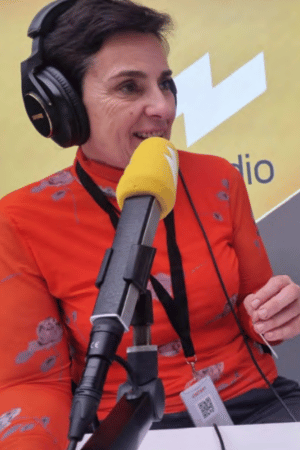
With an impressive education (Universidad de Navarra, a Fulbright scholar gaining a master’s in financial journalism in the US, and a diploma in creative writing at Birkbeck College, London) and a multifaceted CV as a published novelist, football player and fan, not to mention a financial journalist and economist who has branched out into the field of global investment management, working in Ireland as well as the UK, Elena Moya (born Tarragona, 1970) does not run for cover.
Referring to her latest appointment, Moya is up front about her lack of public sector experience, but then she hopes to bring to the job her cultural, journalistic (Bloomberg, Reuters, the Guardian), and financial experience which includes her recent time at Pimco, one of the world’s largest investment managers.
“They are trying to make the Catalan civil service a little bit more like the UK Civil service, elevate more the number of technical appointments, and reduce the number of finger picked (political) appointments and looking for people with a range of skills and capabilities,’ she says, I’ve worked in London for 25 years and in Ireland for three so that puts me at an advantage over many others because I know the landscape.”
Moya has come a long way since first arriving in London, working as a journalist and then publishing her best-selling novel in 2011, Los Olivos de Belchite, described by Professor Paul Preston as a creative “miracle.”
Her literary landscape is populated by memories of the Spanish Civil War and its aftermath, and heady themes like repressed and liberated sexuality, Opus Dei, and the intrigues of finance and big business. Today she admits that her personal favourite is the second of four published novels La Maestra Republicana (2013) a story of female courage in the face or injustice and corruption based in Morella, the picturesque medieval hill-top town in the province of Castellón where in recent years Moya has organised a popular annual literary festival.
This polymath is the first woman to head up the Catalan regional government’s main cultural and trade office in the UK, following in the steps of the Spanish embassy in London which in December last year had appointed to it Emma Aparici Vazquez de Parga, the first ever Spanish woman ambassador to the UK. (See profile in La Revista 268.)
Depending on the political mood music affecting Catalunya and its relations with Madrid, the Catalan delegation headquarters in London, in a discreet three floored premises located on Fleet Street, has on occasions over the years tended to maintain a tactical distance from the Spanish embassy in Belgrave Square, relations turning tense when the issue of a referendum on Independence overshadowed the political landscape, leading to the arrest in Spain or exile of some Catalan politicians.
The President of the Generalitat de Catalunya since 2024 is a former Spanish health minister the LSE educated leader of the Socialists’ Party of Catalunya Salvador Illa who formed the first non-catalanist government in Catalonia since 2010.
‘I get on very well with the Spanish embassy staff …I am committed to healing the divisions that have developed over the years between Catalonia and Madrid… I am independent in the nonpartisan sense …Obviously I am not an extreme right person, but I don’t belong to any party and during my interview process no one asked me about my political preferences,’ Moya tells me.
How does she see this playing out in her new role?
“It’s a technical appointment. But everything I’ve written about and have done has a social conscience which I am proud of and will always defend. I am a total cooperationist and that’s not a political statement. It’s a state of mind, of being. I will always reach out. I believe in building bridges, not burning them. And I honestly think that some of the problems facing Catalunya and Spain are so deep that it’s time to focus on bringing good jobs to Spain, and Catalunya is part of Spain so I will be delighted to work with the Spanish embassy.It’s good for Spain, if Catalonia grows, and it’s the duty of Spain to help us. This is one for all and all for one.
The Spanish embassy is in fact full of Catalans – in the past it was not always thus – and I am delighted if that makes us all more open and willing to talk and understand each other and work for mutual benefit. I do believe in communities helping each other.”
At this point I thought I would bring in the BritishSpanish Society, a cause I know Elena has always supported since her early days as a journalist in London. She warms to the subject: “In a world that everything seems so radicalised- you are either with me or against me-whatever happened to compromise? Whatever happened to the creativity of finding solutions, that both parties understand? To me the best negotiation is not one where one party loses. You know I think we just have to work harder, be more creative, fostering exchange activities, doing things together. It’s called human relationships through trade, through culture. It all makes us more open minded and frankly makes life more interesting. My willingness is to work with the BritishSpanish Society and any association that brings dialogue and exchange to the table.”
So, when she is pitching Catalunya to the British, what would be the selling points? She replies unhesitatingly: “Like Britain, its wealth is built on trade and industry. It has some big companies. Catalans are entrepreneurial.Tourism is huge, with popular destinations like the Costa Brava with an incredible number of planes flying between Catalan airports and Britain. And then there is another area that the Catalan government wants to focus on which is sport, not just at elite male and female levels like FC Barcelona and players like Alexia Putellas now in London, but at youth exchange level and walking holidays…”
We’ve been chatting for close on 45 minutes and Moya has a meeting to get to so I subject her to a quick Q & A.
A perfect day in the UK . How would you spend it?
‘It’s sunny. I take a blanket and a pillow to the nearest London park, and I read a book under the shade of a tree. Then I meet my mates and I play a game of football.’
Your favourite place in Catalunya?
“The Barca stadium. It brings me hope, and regardless of how good or bad the team is, brings me fabulous distraction.”
Your favourite football player?
“Aitana Bonmatí …pure class, fabulous team spirit, humble… zero presumptuousness, fabulous level-headed super star.”
What guests from British and Catalan history would you invite to your dinner table?’
“The late Virginia Woolf (English writer), Mary Beard (English classicist), Gordon Brown (former Labour Chancellor and Prime-Minister), Pep Guardiola (football coach), Ferran Adrià (Master Chef ), and always Tina my partner and you, Jimmy, of course…”
Ever since I’ve known her, Moya has always been open about her sexuality so I ask her as we bid farewell for now, if she is positive about the current international environment or if she is worried about the re-emergence of intolerant forces.
“You know that in my early years in London when we first met, I played for a football team the London Lesbian Kick Abouts (LLKA) and we thought well, being gay in London is fine but it’s not fine in many parts of the world today like Africa or even in parts of the United States and Europe. It’s the same with feminism—there is a renewed macho culture…so in that sense we are going backwards in terms of women and gay rights. But as always I hold up the flag for both causes. I think it’s grossly unfair that there are gay people and women who are treated as a minority and second-class citizens. I think it is abominable. But people who think they can put an end to people being gay are wrong. When I was growing up, I was the only lesbian in my class. Now I have cousins with children and a high number of them are lesbians. It’s much more common than before, so it’s very important that we keep the flag flying for women and gay rights. One of the things I am going to do when I’ve settled back in London is to get back on the football pitch and start playing again. I’m not retiring. I feel I still have a lot to give.”
Elena Moya’s latest book is Chicas, hablemos de dinero (published by Larousse)