
by Graham Watts
Unusually, this year’s London Flamenco Festival began in silence. No music, no singing or clapping, just the sound of the metal on Jesús Carmona’s shoes scraping on the floorboards in semi-darkness, audibly describing the arc of his legs as they swept out around him. The image was made more powerful by Carmona being essentially faceless, the lighting just showing his darkened form like some mysterious masked marauder.
Carmona sings with his trembling feet, exemplifying extraordinary rhythmic zapateado with the cadence rising and falling in harmony with his musicians. His extreme flamenco virtuosity is matched by an innate joy and elegance of movement.
For all the brilliance of Carmona, the dancing highlights of UnYdos were shared with a superb bailaora, Lucía Campillo who danced with maturity humour and sensuality, showing outstanding skills by manipulating the heavy silk fabric of the mantón with great upper arm strength and dexterity, and then evidencing similar lower body strength by moving the heavy material of the bata de cola around with apparent ease to match her body rotations. At times the train whirled around her like a child’s roundabout given a heavy push. It was a masterclass in these challenging flamenco arts The dancers were supported by four outstanding musicians, including the cantaor, Jesús Corbacho, who sang with strong emotional nuances and an immense vocal range, while guitarrista José Manuel Martínez Muñoz (El Peli) showed great sensitivity in providing the only non-vocal instrumental contribution to a stunning evening of pure flamenco artistry, enlivened by a tremendous sense of theatre. The Gala Flamenca, a dream tablao It brought together the sublime skills and powerful stage presences of Eva Yerbabuena, Manuel Liñán, Antonio Fernández Montoya (El Farru) and Tomás de la Molía.
These four dancers were matched with four singers led by the cantaora, Mara Rey, singing with an intensity of passion, her tones both gravelly and mellifluous as the lyrics demanded and moving with all the rhythmic skill of a bailaora.
The emotional intensity of the programme was like a fiery-hot baton passed between the dancers in their lengthy solos. Liñan, who was once again the gala’s artistic director, performed in a bata de cola, manipulating a mantón at the same time as swirling the dress, simultaneous skills that required great dexterity and timing. After demonstrating his considerable skill with shawl and dress, Liñan lifted the latter to show his equally elite capacity with the locomotive speed of his footwork.
El Farru – a masterclass in compás.
He began his lengthy solo with a walking cane, a male-presenting equivalent to the mantón, which is not often seen these days, using it as a third leg, banged on the floor in rhythmic harmony with his fearsome feet. It was a masterclass in a cycle of beats with emphasised accents in the mix. The tiny figure of La Yerbabuena, who turned 56 just days after this performance, danced with immense gusto, bringing together flawless technique, passion and superb stagecraft.
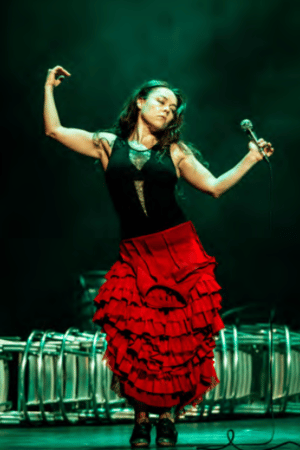
Rocío Molina, another great bailaora.
She enjoyed a show of her own when the Gala was followed by Calentamiento, a one-night- only, two-hour tour de force by, which began and ended without an audience!
Calentamiento has heaps of meanings from ‘getting hot’ in terms of sexual arousal, or, without inuendo, it might simply mean ’feverish’ or ‘warming up’. In Molina’s world it probably means all of the above but the emphasis on the latter is evident from the moment the audience arrives since the show’s star is already on stage performing a sequence of exercises to Spanish pop music with a particular emphasis on the oft-repeated Nadie Te Quiere Ya, which became a musical leit-motif, eventually sung by four backing singers in a box.
For the first hour this was a one-woman show with Molina performing the same 12-beat rhythmic exercise, with minimal variations – fast as in bulerías and slow as in soleá with a similar, but faster driving tempo of an alegrías – all-the-while talking, often hilariously, to the audience. Molina’s feet accelerated effortlessly from 140 to 180+ beats per minute, clearly moving instinctively without any apparent concentration. She explained that this warm-up is the basis for her technique and she had been performing the routine for 35 minutes every day for 35 years, since she was seven years old! As her skin began to redden and glisten with sweat, Molina explained that it was necessary to break through the pain barrier to reach an enlightened state where el duende, the spirit of flamenco, took over. Watching the same footwork performed repeatedly while she spoke in a deadpan delivery should have been boring, but it was riveting!
She was eventually joined onstage by José Manuel Ramos (El Oruco), a master of flamenco compás who took on a role as Molina’s instructor, with a macho air of arrogance. This section erred towards uncomfortable viewing with the edgy abusiveness of their relationship perhaps referencing the sexual aspect of the show’s title.
Four singers who had been confined (unseen) to a tall but narrow box for most of the show, finally exited and piled chairs onto Molina’s upper body and, as if in a circus trick, holding around 20 lightweight metal chairs, she started the same 12-beat zapateado cycle. The craziness didn’t end with the curtain call because Molina simply carried on dancing the same rhythmic cycles as the house lights went up. In an extraordinary feat of endurance, she didn’t stop until everyone had left the auditorium!
Marco Flores – a captivating and charismatic entertainer.
The festival ended in an unusual place at Sadler’s Wells East on the former Olympic Park, a stone’s throw from the stadium that is now home to West Ham United, with a men-only performance that was both intriguing and mystifying.
Flores is a distinctive flamenco choreographer and performer, a free styler who brings contemporary expressiveness, including an essence of queer identity, to a pioneering emphasis that is pushing the boundaries of flamenco.
Rayuela is both the name of a popular children’s game, like hopscotch, and the title of a 1963 novel by Argentine writer Julio Cortázar, a stream-of-consciousness work that can be read either in a linear progression through 56 chapters or according to a table of instructions, literally ‘jumping’ through and across the chapters (missing one out) like a literary game of hopscotch, and providing multiple possible endings.
This explanation is important because Flores has constructed Rayuela similarly, as a series of chapters that can be inter-changed and rearranged to form a performance of the same ingredients but differently ordered. Dance deconstruction in the context of flamenco. Flores opened and closed the 75-minute show, hunched over and staring at the floor as if looking for an errant contact lens.
Flores has a highly refined flamenco technique, including the ability to handle castanets fluidly in tempo with the fast rhythms of his feet, and an innate, flexible musicality that allows his movement, the tapping of the castanets, and strong zapateado to swerve into the rhythms of his two colleagues, the outstanding guitarrista, José Tomás, and Manuel de la Nina, a cantaor with an impressively varied vocal range.
Usually, the spirit of flamenco leads a performance to build an exciting momentum that ends with a flourish, but Rayuela was counter-intuitive to that norm, gradually winding down to the full stop of Flores once again searching for that missing contact lens, and in doing so ending the Flamenco Festival as it had begun, in silence.
Graham Watts, a member of the BritishSpanish Society, is an international dance writer and critic, President of the Critics’ Circle and Chair of the National Dance Awards.
Photos: Courtesy of Sadler’s Wells