
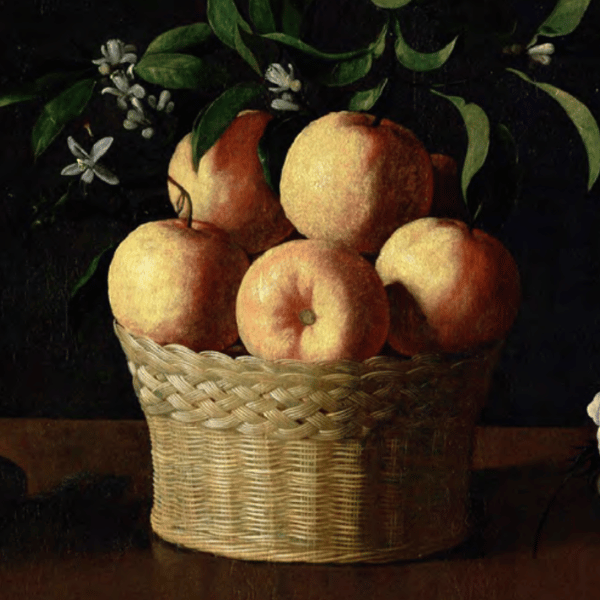
Following London’s critically acclaimed exhibition at London’s National Gallery earlier this year, a magnificent retrospective of some the great master and his son’s most accomplished paintings has moved to Paris, before crossing the Atlantic next year.
Zurbarán is a painter passing strange. His canvases sing with exquisite details — a shimmer of light in the hollow of a plate, or the run-through elbow of a coarse habit — that assure us that what we see is real. But almost everything he painted, in his individual and idiosyncratic way, was not. The episodes from Biblical stories, saints’ lives and histories of religious orders that he laboured over had to be imagined, invented and given fresh and enticing visual form. This was, of course, the lot of almost every artist in Counter-Reformation Spain, but none of them, even the other stars of the 17th century, the cerebral Velázquez and the celestial Murillo, come close to Zurbarán’s lumpen majesty.
The National Gallery’s recent exhibition on Zurbarán — the first full-scale retrospective on the artist presented in Britain — featured 42 of his and his son Juan’s most accomplished paintings. With my co-curators, Francesca Whitlum-Cooper and Imogen Tedbury, I worked to present Zurbarán not only as the greatest Spanish religious
painter of his time, but as an exacting and innovative artist, just as capable of telling stories at grand scale, in huge canvases that adorned churches and monasteries, as in the intimate and affecting paintings he made for homes and private chapels in Seville and Madrid. Organised in collaboration with the Musée du Louvre and the Art Institute of Chicago, the show — a great popular and critical success in London — travels to Paris (4 October 2026–25 January 2027) and Chicago (28 February–20
June 2027). Francisco de Zurbarán was born in 1598 in a white-washed hamlet on the barren plains of Extremadura, north of Seville, the metropolis where he would make his name. He trained there as a teenager — learning to paint, gild and carve and rubbing shoulders with Velázquez, who was just six months younger — then decamped for a market town near his birthplace, where he set up shop. We know little about his time there, save that he married, and then remarried, well. Before long his talents, and perhaps his ambition, surpassed these humble surrounds, and he returned to Seville, one of Europe’s richest and most populous cities.
The first painting that he signed and dated that has survived, the superlative, life-size “Crucifixion”, opened the exhibition at the National Gallery. A muscular, pallid Christ hangs on a rough wooden cross, cut out of an inky black background by strong light that falls from the right. The remarkable three-dimensional effect equals or even outstrips that of the hyper-realistic painted wooden statues that were then among the highest expressions of art in Seville. In a witty gesture, Zurbarán applied his signature and the year, 1627, to a trompe l’oeil piece of paper crumpled against the base of the cross, defying viewers to separate representation from reality. The painting stunned Seville. Here was a painter, the city council declared not long after, beseeching him to stay, who was every inch a consummate artist. Stay he did, working for the city’s many religious institutions, while also taking commissions from further afield. In 1634, he even travelled to Madrid to paint for the king, Philip IV. There he completed a series of canvases for the Palace of the Buen Retiro that depict the Labours of Hercules. They are compelling if ungainly paintings: the male nude in action was a new test for Zurbarán’s abilities, and his galumphing Hercules, rather than dispatching his tasks with the froideur of a demigod, huffs and puffs, straining every sinew.
While in Madrid he also painted one of the most outlandish canvases of the seventeenth century: the “Colossal Head”, on loan from the Museo del
Prado, whose curators attributed the painting to Zurbarán only a few years ago. The huge picture, two and a half metres tall, is a close-up view of a man’s head — nothing else quite like it exists in Baroque art. A Dutch envoy, who saw the painting in the Buen Retiro in 1661, was as non-plussed and intrigued as visitors to the National Gallery were. Is this a giant, a stony-faced guardian figure, or somehow related to a theatrical production? We simply do not know. All the more reason to
marvel.
Zurbarán never left Spain. His paintings, however, did, and in great numbers. Seville was the gateway to Spain’s far-flung territories in the Americas, and the painter and his workshop sent more than a hundred canvases across the Atlantic. These were often painted in large series, like the twelve paintings that depict Jacob and the Twelve
Tribes of Israel that have hung in the Long Dining Room of Auckland Palace in County Durham since 1756. Two of these paintings, “Joseph and Asher”, were cleaned and restored at the National Gallery ahead of the exhibition, and the painter’s impressive knack for conveying the texture and drape of rich, patterned textiles, one of the great strengths of his art, is now on especially lustrous show.
But Zurbarán was perhaps at his very best when his aims were modest, his subjects small. There is no painting in the annals of Spanish art as exquisite and absorbing as “Still Life with Lemons, Oranges and a Rose.” This masterpiece dazzles with diminutive details: light plays over waxy citrus rinds and arcs through the water in the cup on the right, beside which rests a thornless rose. Whether or not Zurbarán intended the painting to be sacred — the cup of water and rose are common symbols of the Virgin Mary — it inspires meditative contemplation. The same is true of the austere “Agnus Dei”. A little, ivory-fleeced lamb hooves bound, is laid out before us on a stone
ledge, so real that we almost forget that it is also divine. To commingle the things of our world with what might lie beyond, things and places seen only in mystical visions, almost without our noticing, is the subtle accomplishment of Zurbarán’s art.
Who was Zurbarán? We know precious little. Some documents survive, but none give us more than a passing glimpse of his private life. No portrait of him is known. We have to make do, instead, with the cryptic painting that closed the exhibition at the National Gallery. In it, a reverent painter, with brushes and palette in one hand and the other across his chest, gazes up at the crucified Christ. Some have seen this painter as Zurbarán himself, though it is unlikely that it is a true self-portrait. No matter. It is the closest we come to laying our eyes on this superlative artist, who brought together, like no one else, the divine and the everyday.
Author: Dr Daniel Sobrino Ralston is Centro de Estudios Europa Hispánica (CEEH) Associate Curator of Spanish Paintings, National Gallery, London