
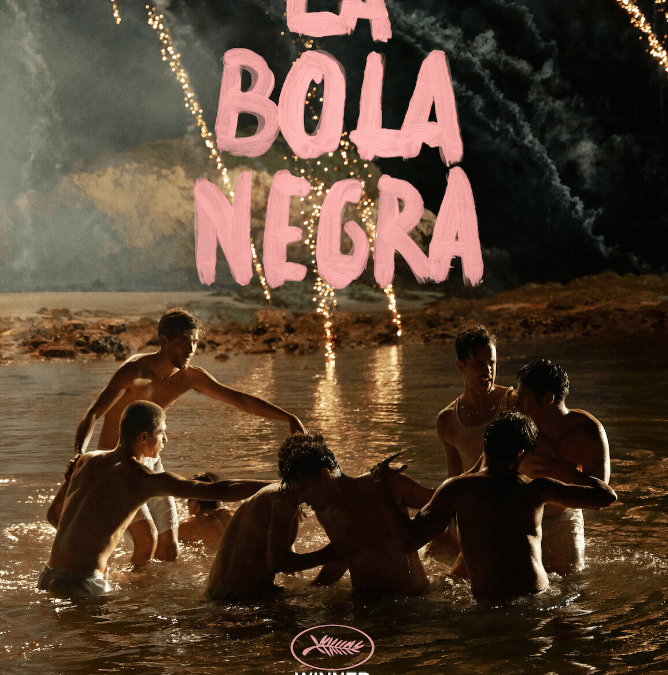
La Bola Negra: Review by Jimmy Burns Marañón
As instantly engaging cinema goes, an opening scene of La Bola Negra takes some beating in terms of its human drama and similarly impactful symbolism.
It’s the Spanish Civil War, and the poor inhabitants of a small isolated rustic village gather in daylight in seeming normality: a mother scrubs her naked boy child in a steel tub, a labourer brings in his donkey from the field, and the largely elderly members of the village band struggle to tune their array of wind instruments, with the youngest among them a young adult called Sebastián (played by the actor and musician Álvaro Lafuente Calvo) tentatively blowing his trumpet. Political allegiance is symbolised by a nationalist flag, and a child forcing his companion to turn his waving hand into an outstretched fascist salute.
Against this opening of discordant notes, the sky has been suddenly filled with incoming Italian war plans, the roar of their engines shattering the peaceful rural idyll. Initially greeted enthusiastically as a liberating presence, it all turns into a shocking event, as the planes attack the village with bombs and machine fire, destroying houses and killing inhabitants.
In the midst of the carnage -whether a mistaken target or deliberate collateral damage is left as an open question – , Sebastián runs for his life, and plunges into the local river, to be confronted by armed nationalist soldiers as he struggles ashore. Only repeated cries of ‘Arriba España’, the Falange slogan, saves him from summary execution and he is enlisted.
Thus, is introduced Sebastián one of three characters whose lives across different periods of time and location, straddle this absorbing and beautifully made film. His escape from his broken village involves him scrambling through the smouldering ruins of a chapel, clutching the arrows piercing a stone statue, seemingly that of Saint Sebastian, as he climbs over the shattered icon of gay martyrdom.
Sebastián’s homosexuality is otherwise not immediately apparent-indeed this is a film about sublimated sexuality , struggling to be given free expression in interconnected scenes across three time zones-the year of the Republican government prior to the military uprising, the Civil War, and modern Spain set in 2017.
Once enlisted by the nationalist side, Sebastián is put on guard duty in a local hospital, after witnessing an army truck unloading a pile of unidentified mangled bodies picked up from the front, with only a couple of survivors. Humanity struggles to shine through but shine it does, if only briefly. One of the surviving wounded, initially accepted by caring nuns and medical staff as patients, is Rafael (Miguel Bernardeau), a handsome former footballer player turned Republic soldier, who Sebastián falls in love with, while standing guard by his bedside, and tending to his wounds .
After making a failed escape bid, Rafael is taking off with other Republican prisoners to be shot. Sebastián is not only forcefully recruited to be part of the firing squad, but ends up personally shooting his friend, at his insistence, after initially refusing to do so, in an act of witness to his sacrifice.
In a work of fiction drawing on true stories, a historical literary character that links the different times frames and drives the underlying the narrative is the poet Federico Garcia Lorca who was executed by the nationalist side in the early months of the Civil War.
We glimpse Lorca in the pre-Civil War days as part of a theatre group, where he meets Rafael, and being drawn into the mysticism of the gypsy culture , when an old woman prophesies his death metaphorically, with his body submerged in freezing snow, (he was in fact buried in an unmarked grave with other victims) all the colour and warmth of his creative exuberance crushed and ultimately submerged .
Lorca’s death is anticipated in a scene set in the early 1930’s , when he was ostracised and resented by the extreme right establishment in his native Granada. The year is 1932. A fictitious character, again strikingly handsome, called Carlos (played by Milo Quifes) is, like Lorca, a young man of a good family in Granada, whose membership of an elite men only club is turned down on the grounds of his rumoured homosexuality.
In an oppressive ceremony involving, a committee of civilians, military, and clergy, representing the resurgent reactionary Spain, cast their vote with a decisive majority of black against white balls, thus ‘blackballing’ him.
The title of the film alludes to Lorca’s own persecution, but also refers to an unpublished work in which he overtly proclaims his homosexuality. The work resurfaces among the papers inherited by a bearded overweight gay Spaniard called Alberto we meet in the Spain of 2017.
Alberto (Carlos González),while free to express his sexuality, is a troubled character. A dark cloud of personal dysfunctionality and creative unfulfillment seems to hang over him. A failed playwright, he is doing some peculiar postgraduate research into queer identities, listening to old forgotten gramophone records from the 1920s.
He lives in a small Madrid flat, somewhat depressed by the frivolity of his hedonistic young partner, against which the platonic encounters of other male encounters in the film seem viewed through a romantic prism.
The real challenge of Alberto’s life is having to cope, as the seemingly only child, with the tortured soul of Teresa his mother, a hard drinker and cocaine user who refuses to support her son in delving into the past. She is played by Lola Dueñas, one of Pedro Almodóvar’s regular actresses, here reprising a female figure on the edge as her son discovers that his late maternal grandfather was Sebastián who after the Civil War had left his family and gone to live discreetly with a male lover.
Sebastián is credited as co-producer of the film directed by two of his disciples, the creative duo Javier Calvo and Javier Ambrossi . Among the overwhelmingly sympathetic characterisation of the trials and tribulations of homosexuals and their female companions, is a wonderfully evocative Civil War cabaret act by Penelope Cruz-her fellow ‘actresses’ including whores and transvestites-leading to one of the memorable phrase of the film – ‘Transvestitism is all about possibilities which war negates.’
Elsewhere the camera takes us past fantasy scenes of flirtatious sailors camping it up along the waterfront, and naked soldiers with statuesque bodies romping on the beach – a Spain only imagined for large swathes of its intolerant and conflictive history.
The final stages of the film has Alberto not only discovering that his maternal grandfather was homosexual but and that his bequest was a document that Lorca had passed to a mutual friend for safe keeping.
Along with other students, Alberto attends a talk by visiting Irish American academic and expert on Lorca (played by Glen Close). She speaks about the struggle Spaniards find in reaching an agreed narrative of their history, based on forensic research, it to foreign hispanists to do the digging .
It is then then Alberto hands the academic his grandfather’s bequest – an unpublished work of Lorca, entitled La Bola Negra, an open statement of the poet’s homosexuality , now revealed as an act of liberation, and redemption.
This a powerful film, ambitious in its cinematography, with some fine acting, evidently defiantly homo erotic in several of its scenes, yet with a conscious appeal to a broader international audience with a social conscience, not to mention the millions of Lorca fans. Some of them may take issue by this focus on the poet’s sexuality while others will accept that therein lies an understanding of his true self and poetic genius, and the terrible tragedy of his death.
This is an unsettling and thought-provoking piece of work, which loosely mixes facts and fiction, and stretches the imagination. While falling short of a masterpiece, it is is arguably a worthy contender to the best foreign film category in next year’s Oscars.
Jimmy Burns attended the private showing on November 11 of La Bola Negra hosted by the Cultural Office of the Embassy of Spain in London, at the Curzon Cinema, Mayfair.